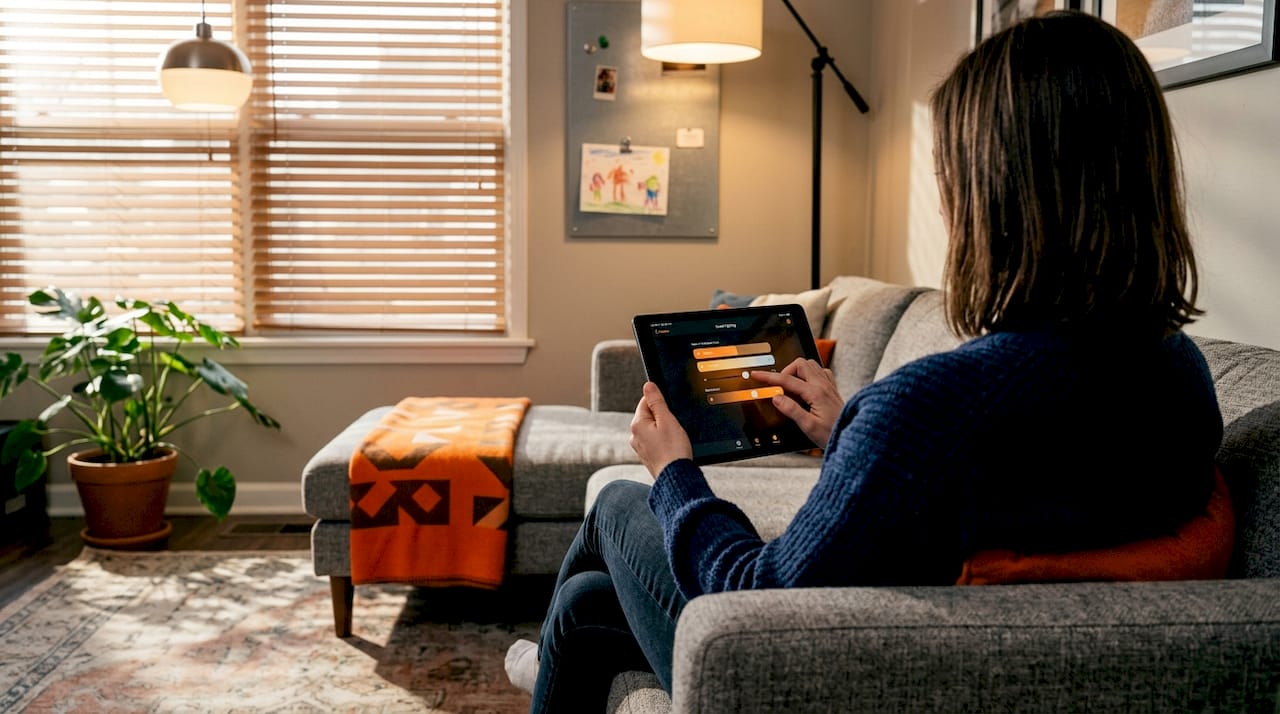
Ever felt like creating that perfectly lit, magazine-worthy room was a secret only professional designers knew? Well, get ready for a game-changer! Forget the old assumption that beautiful, layered lighting is reserved for homeowners with a designer on speed dial. AI-powered lighting tools have quietly rewritten the rules, making it possible for anyone to visualize, customize, and confidently choose fixtures that genuinely suit their space.
No more guessing if that pendant light will overwhelm your dining room, or if that floor lamp will actually cast the right glow for your reading nook. With artificial intelligence stepping into the design arena, personalized lighting solutions are no longer a luxury but an accessible reality. In this comprehensive guide, we'll walk you through exactly how these tools work, why input quality matters more than most people realize, and how to apply AI-driven recommendations room by room, so your lighting upgrade feels intentional rather than accidental. Let’s illuminate your world!
Table of Contents
- Understanding the Foundations of Lighting Solutions
- How AI Visualization Tools Shape Custom Lighting
- The Role of Quality Input and Human Touch in AI Lighting
- Applying AI Solutions: Practical Workflows for Every Space
- Our Perspective: Where AI Shines and Where It Stumbles
- Find Your Next Lamp with AI-Powered Recommendations
- Frequently Asked Questions
Key Takeaways
| Point | Details |
|---|---|
| AI makes lighting accessible | Affordable tools now allow anyone to personalize lighting without hiring experts. |
| Quality inputs are vital | Great results require clear photos and thoughtful style selections for your spaces. |
| Human review is essential | Review and adjust AI recommendations to ensure they suit your daily use and taste. |
| Practical workflows save time | Following step-by-step guidance lets you quickly try new lighting setups for every room. |
Understanding the Foundations of Lighting Solutions
Before diving into how AI transforms the process, it’s vital to understand what makes lighting solutions impactful and how classic approaches compare. Lighting isn't just about brightness; it's about shaping atmosphere, highlighting features, and enhancing functionality.
At their core, effective lighting solutions involve three interconnected decisions: placement (where light falls and from what angle), intensity (how bright or dim the output is), and style (the fixture’s visual language and the color temperature of its light). Get all three right, and a room feels alive, welcoming, and perfectly functional. Miss even one, and the most beautifully furnished space can feel flat, uncomfortable, or impractical.
Modern lighting design typically relies on a concept called "layered lighting," which involves combining three types of light to achieve a balanced and versatile scheme:
- Ambient Lighting: This is your general, overall illumination. Think of ceiling fixtures, recessed lights, or large pendants that provide a comfortable level of light throughout the room. It's the foundation upon which all other lighting layers are built.
- Task Lighting: Focused light designed for specific activities. This includes desk lamps for working, under-cabinet lights for cooking, or reading lamps beside a sofa. Task lighting prevents eye strain and ensures safety.
- Accent Lighting: Used to draw attention to specific features, like artwork, architectural details, or plants. Picture track lighting, picture lights, or wall sconces that create dramatic shadows and highlights, adding depth and visual interest.
Traditionally, achieving this layered approach relied almost entirely on manual planning and a fair amount of expensive trial and error. A homeowner might consult a catalog, purchase a fixture, install it, and only then realize the scale was wrong, the warmth clashed with their wall color, or it simply didn't provide enough light for its intended purpose. Professional designers, with years of experience and a deep understanding of light physics and aesthetics, could craft these schemes, but that expertise came at a significant cost, putting it out of reach for most renters and budget-conscious homeowners. They simply made do with basic overhead lights and perhaps a floor lamp.
What changed everything was the arrival of AI tools trained on vast libraries of interior design imagery. These systems use spatial recognition and machine learning on design image datasets, prompt engineering for styles, and iterative generation to produce realistic lighting renders. Object detection allows the AI to identify furniture, wall colors, and architectural features within a room photo, then model how different fixtures would interact with those elements. The result is a recommendation engine that feels less like guesswork and more like having a knowledgeable collaborator.
Here is a quick look at what modern AI lighting tools actually analyze:
- Room geometry: Ceiling height, wall proportions, and window placement. The AI understands how light will bounce and reflect within these dimensions.
- Existing color palette: Wall paint, flooring tone, upholstery hues, and even decor items. Light interacts differently with various colors and textures, and AI can simulate this.
- Furniture style: Mid-century, industrial, Scandinavian, maximalist, and dozens of other aesthetics. This helps the AI suggest fixtures that complement your existing decor.
- Natural light levels: Estimated based on window size and orientation data you provide. This is crucial for understanding how artificial light will supplement or balance natural light.
- Fixture scale: Whether a pendant, floor lamp, or recessed option suits the proportions of your space and other furnishings.
“The shift from manual trial-and-error to AI-informed recommendations is not just a convenience upgrade. It is a fundamental democratization of design expertise, bringing sophisticated lighting design within everyone's reach.” — Find a Lamp editorial team
Exploring dimmable lighting options alongside AI recommendations is a smart early move, since intensity control is one of the most underrated elements in a successful lighting scheme. And if your space extends outdoors, artistic outdoor lighting deserves the same AI-informed attention as your interiors. Understanding essential home lighting design tips also gives you a broader sense of where the industry is heading and how AI can help you implement them.
How AI Visualization Tools Shape Custom Lighting
With the basics clear, let’s examine how these new AI tools actually work and what they mean for your home lighting decisions. This is where the magic truly happens, transforming your design dreams into tangible visuals.
The visualization workflow is where things get genuinely exciting. Rather than imagining how a lamp might look in your living room, you can now upload a photo of that room, select a style preference (say, “warm industrial” or “soft Scandinavian”), and receive a rendered image showing your actual space with new fixtures placed inside it. The AI handles the perspective matching, shadow simulation, and color temperature blending. What you see is not a generic showroom mockup; it is your room, reimagined with startling accuracy.

Tools like RoomsGPT and VisualizeAI offer free tiers with style selectors, making entry-level experimentation genuinely accessible. Paid tiers typically unlock higher-resolution renders, more style options, and the ability to save multiple room variations side by side for comparison. These platforms utilize advanced algorithms that not only detect existing elements but also predict how light will interact with different materials, textures, and finishes, giving you a remarkably realistic preview.
Here is how the AI visualization workflow compares to the traditional approach:
| Factor | Traditional Method | AI Visualization Method |
|---|---|---|
| Time to first visual | Days to weeks (waiting for designer mockups, physical product delivery, or returns) | Minutes (upload, select, generate) |
| Cost | High (designer fees, costly returns, wasted purchases) | Free to low-cost (for advanced features) |
| Personalization | Limited to catalog browsing or designer's portfolio | Based on your actual room photo and specific preferences |
| Revision flexibility | Costly and slow, often requiring new purchases or re-installations | Instant iteration, endless variations at the click of a button |
| Accuracy of scale | Guesswork, measuring tapes, and hoping for the best | AI-modeled proportions, showing how fixtures fit your space |
| Style matching | Manual mood boarding, endless Pinterest scrolling | Automated style analysis, suggesting cohesive looks |
| Shadow & Light Play | Pure imagination or professional renderings | Realistic shadow simulation and light distribution |
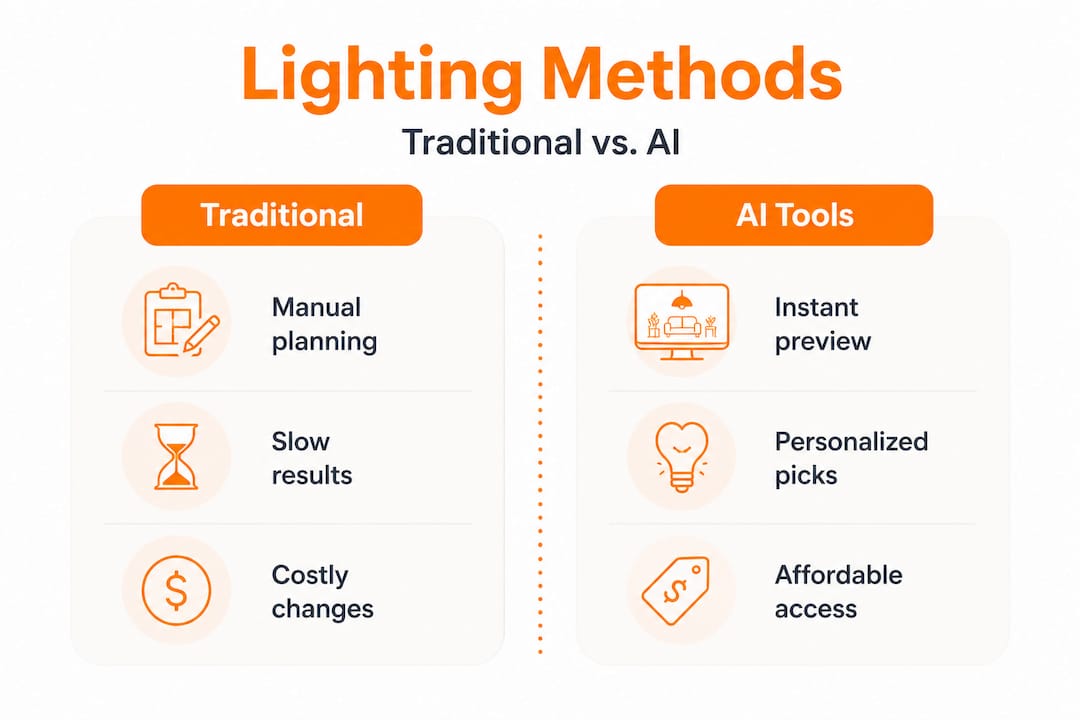
The speed advantage alone is transformative. A homeowner who previously spent weeks flipping through catalogs and Pinterest boards can now test a dozen fixture combinations in an afternoon. For renters especially, this means fewer costly mistakes on items that cannot be returned or require complex installation. It’s like having an interior designer and a virtual showroom rolled into one convenient package.
Statistic callout: Interior design platforms report that users who visualize a fixture in their actual space before purchasing are significantly more likely to feel satisfied with their final choice, reducing the impulse to return items and start over by up to 40%.
Pro Tip: Always verify AI-generated renders against your room’s real daylight conditions. AI tools typically model artificial lighting scenarios well, but morning sun streaming through east-facing windows can shift how a warm-toned fixture actually reads in your space. Take the render as a strong starting point, then hold a physical swatch or finish sample in the room at different times of day to ensure perfect harmony.
For bedroom spaces specifically, exploring modern bedroom lighting through an AI lens reveals how dramatically the right pendant or bedside sconce can shift the mood from clinical to immersive. Outdoor spaces benefit equally from this approach. A well-designed smart home lighting plan uses the same layering principles as interiors, and AI tools are increasingly capable of handling exterior renders too. Browse modern outdoor lighting to see how these principles translate beyond your front door.
The Role of Quality Input and Human Touch in AI Lighting
As powerful as these tools are, they depend on quality inputs and your involvement. Think of AI as a brilliant assistant; it can only work with the information you provide. Here is how to make the most of AI recommendations and ensure your results are truly spectacular.
There is a tempting misconception that AI tools do all the heavy lifting. They do not. The quality of what you put in determines the quality of what comes out. A blurry, poorly lit room photo taken at an odd angle will generate a render that misrepresents your space. Conversely, a crisp, well-lit photo taken from a corner to capture the full room will produce something genuinely useful and inspiring. It’s the classic "garbage in, garbage out" principle.
“AI democratizes lighting design for homeowners and renters by providing accessible, free and low-cost tools for visualization without professional hires, but success hinges on quality inputs and human verification.”
Here is a step-by-step process for maximizing your AI lighting tool experience:
- Photograph Your Room Correctly: This is arguably the most critical step.
- Angle: Stand in a corner and shoot diagonally to capture as much of the space as possible, including ceilings, walls, and flooring.
- Lighting: Use natural daylight if available, turning off artificial lights to get a true representation of the room's base light. Avoid flash, which flattens depth and distorts colors.
- Clarity: Ensure the photo is in focus and well-exposed. A high-resolution image gives the AI more data to work with.
- Declutter: While not strictly necessary for the AI to function, a tidier room helps the AI focus on the architectural elements and provides a cleaner canvas for its suggestions.
- Note Your Room’s Fixed Elements: Provide as much detail as possible. Write down ceiling height, flooring material, existing wall colors, and any architectural features like exposed beams, crown molding, built-in shelving, or unique window shapes. Some tools let you input these manually, giving the AI a richer understanding of your space.
- Choose a Style Direction Before You Upload: Don't go in blind! Arriving with a rough aesthetic in mind (warm minimalist, eclectic maximalist, soft industrial, modern farmhouse) helps you evaluate the AI’s suggestions critically rather than being swayed by novelty. Create a mini mood board or jot down keywords that describe your desired vibe.
- Run Multiple Style Iterations: Do not stop at the first render. Most tools allow you to cycle through several aesthetic directions or generate variations of a single concept. Compare them side by side, paying attention to how different fixtures alter the room's mood and functionality.
- Cross-Reference with Real Product Specs: Once the AI surfaces a fixture you love, look up its actual lumen output (brightness), color temperature (measured in Kelvin, e.g., 2700K for warm, 5000K for cool), and precise dimensions before purchasing. AI is great for visualization, but real-world specs are essential.
- Assess the Render in Context: Print or display the render on a large screen in your actual room. This sounds low-tech, but it is surprisingly effective for catching scale issues, understanding how colors translate, and getting a feel for the proposed light distribution.
Human review is not optional. It is the step that separates a lighting upgrade that looks like a magazine spread from one that just looks expensive. AI provides the inspiration and the visual shortcut. You provide the practical judgment, considering factors like your daily routines, the amount of natural light at different times of day, and your personal comfort. For living rooms, browsing industrial living room lighting alongside your AI renders gives you a real-world product anchor. For bedrooms, artistic bedroom inspiration can spark ideas that the AI might not surface on its own.
Pro Tip: After receiving AI suggestions, physically visit a lighting showroom or order small swatches of the finish materials. Brushed brass in a render can look quite different under your specific room’s light spectrum compared to how it appears on your screen.
For more tips on preparing your space for design tools, check out this guide on how to take good interior photos.
Applying AI Solutions: Practical Workflows for Every Space
Ready to put these tools to work? Here is how you can apply definitive lighting solutions step by step in any room, leveraging AI to tailor light to each space's unique needs and functions.
The beauty of AI-driven lighting tools is that they are not one-size-fits-all. They adapt to the specific demands of each room type. A hallway needs directional, welcoming light that guides movement and enhances safety. A living room needs layered ambient and accent sources that flex between social and relaxed modes. A bedroom demands warmth, dimmability, and intimacy above almost everything else. A kitchen requires bright, shadow-free task lighting for food prep, balanced with ambient light for dining.
Here is a quick-reference table for room-specific AI lighting priorities:
| Room | Primary Lighting Need | AI Tool Focus | Fixture Type to Explore |
|---|---|---|---|
| Living Room | Layered ambient, task, and accent for versatility | Style matching, scale, mood creation | Floor lamps, pendants, table lamps, recessed lights, wall sconces |
| Bedroom | Warm, dimmable, intimate, and functional task lighting | Color temperature, ambiance, bedside task | Sconces, table lamps, ceiling fans with lights, dimmable pendants |
| Kitchen | Bright, shadow-free task lighting; ambient for dining | Task area illumination, overall brightness, accenting islands | Under-cabinet lights, recessed lights, pendants over islands, track lighting |
| Dining Room | Dramatic focal point, adjustable ambiance for meals | Focal point creation, table illumination, dimmability | Statement pendants, chandeliers, wall sconces, recessed lights |
| Home Office | Task-focused, glare-free, stimulating yet comfortable | Intensity analysis, ergonomic placement, visual comfort | Desk lamps, ceiling fixtures, floor lamps for ambient fill |
| Bathroom | Even, shadow-free illumination for grooming; relaxing ambiance | Even light distribution, color rendering, moisture resistance | Vanity lights, recessed lights, shower lights, decorative sconces |
| Hallway/Entryway | Directional, welcoming, safety-focused | Placement modeling, flow guidance, accenting features | Wall lights, pendants, flush mounts, picture lights |
| Outdoor Spaces | Safety, security, ambiance, highlighting landscape | Exterior rendering, weather resistance, pathway illumination | Post lights, wall lanterns, step lights, string lights, uplights |
Tools like RoomsGPT and VisualizeAI make this room-by-room approach accessible without any professional fees. The free tiers are genuinely useful for early-stage exploration, while paid upgrades make sense once you are committed to a specific direction and want high-fidelity renders for final decision-making. These tools can help you experiment with different fixture types and placements, letting you see how a single change can dramatically alter the feel of a room.
Practical tips for getting the most from your AI workflow:
- High-Resolution Photos: Always upload photos at the highest resolution your device allows. More pixels mean more data for the AI, leading to more accurate and detailed renders.
- Experiment with Color Temperature: Test both warm (2700K-3000K, cozy, inviting) and cool (3500K-4000K, crisp, energetic) color temperature scenarios in your renders. See how they interact with your wall colors and furniture finishes.
- Explore Beyond Your Comfort Zone: Use the AI’s style selector to explore aesthetics you would not normally consider. You might discover a new favorite look!
- Save Everything: Save every render variation before moving on, since you may want to revisit earlier options or combine elements from different suggestions.
- Cross-Reference with Collections: Cross-reference AI suggestions with curated collections on platforms like Find a Lamp for real-world product availability, reviews, and detailed specifications.
- Consider Smart Lighting Integration: Many AI tools can suggest smart lighting options. Think about how these can enhance your lifestyle with schedules, voice control, and color-changing capabilities.
For hallways specifically, industrial hallway lighting offers a surprisingly versatile aesthetic that AI tools tend to recommend for spaces with exposed brick, concrete flooring, or dark-painted walls. For living rooms, modern living room lighting provides a strong starting point for AI-assisted style matching. A detailed lighting workflow guide from a reputable source can also help you structure your process from first photo to final purchase.
Our Perspective: Where AI Shines and Where It Stumbles
Let us wrap up with an honest look at where AI lighting tools absolutely shine and where you will still need a bit of human creativity and judgment to achieve truly stunning results.
We have spent considerable time working with AI visualization tools, and our honest assessment is this: they are extraordinary for inspiration, visualization, and narrowing down choices, but they are still developing their understanding of true nuance and lived experience. The gap between a stunning render and a genuinely successful, comfortable, and functional lighting scheme is almost always filled by human judgment, not algorithmic precision.
Where AI genuinely excels is in speed, accessibility, and inspiration. For a first-time homeowner who has never thought deeply about layered lighting, an AI tool can compress weeks of research into an afternoon. It surfaces fixture styles they would never have discovered through casual browsing, and it makes abstract concepts like “warm ambient layering” suddenly visible and tangible. This democratization of design expertise is not a small thing; it is a genuine leap forward in how people engage with their living spaces, empowering them to make informed choices with confidence.
AI's strengths include:
- Rapid Visualization: Instantly seeing how different fixtures look in your actual room.
- Style Exploration: Suggesting cohesive styles you might not have considered.
- Scale & Placement Preview: Helping you understand if a fixture is too big, too small, or poorly placed.
- Cost-Effectiveness: Reducing the need for expensive designers or costly returns.
- Bridging the Imagination Gap: Making abstract lighting concepts concrete and understandable.
Where AI stumbles, however, is in the lived experience of a room. It cannot know that your kitchen gets blinding afternoon sun from the west, making a cool-toned pendant feel harsh by 4 PM. It cannot account for the fact that your ceilings have a slight texture that scatters light unpredictably, or that a certain material finish in your room absorbs light more than expected. It cannot feel the difference between a room that looks good in a render and one that feels good when you are actually sitting in it at the end of a long day, with all its sensory inputs.
AI's current limitations often include:
- Sensory Nuance: Inability to fully grasp how light *feels* (e.g., glare, warmth, coziness).
- Unique Architectural Quirks: Struggling with highly unusual room shapes, angles, or specific historical details.
- Material Interaction: While improving, it may not perfectly simulate how light interacts with every unique texture or finish.
- Emotional Connection: It can suggest aesthetically pleasing options, but the emotional resonance of a space is deeply personal.
- Future-Proofing: It might not anticipate how your needs or preferences for a space could evolve over time.
The most effective approach we have seen, and the one we genuinely recommend, is to treat AI as your first collaborator, not your last. Use AI recommendations for every space to generate a shortlist of directions. Then, bring your own sensory knowledge of the room, your daily habits, and your personal aesthetic to filter that shortlist down to something real, livable, and truly *you*. The homeowners who get the best results are not the ones who follow AI suggestions blindly; they are the ones who use those suggestions as a launching pad for their own creative instincts and practical considerations.
Professional designers still produce results that AI cannot replicate, particularly in complex, multi-zone spaces where lighting needs to perform differently across a single open floor plan, or for bespoke, high-end installations. But for the vast majority of rooms in the vast majority of homes, AI tools now offer something genuinely valuable: